Durgabai Deshmukh 1909–1981
Chapter 09 1953 – today

The Work Continues

She died on 9 May 1981, aged seventy-one. By then almost nothing she had built still belonged to her — which is the strictest test an institution builder can pass.

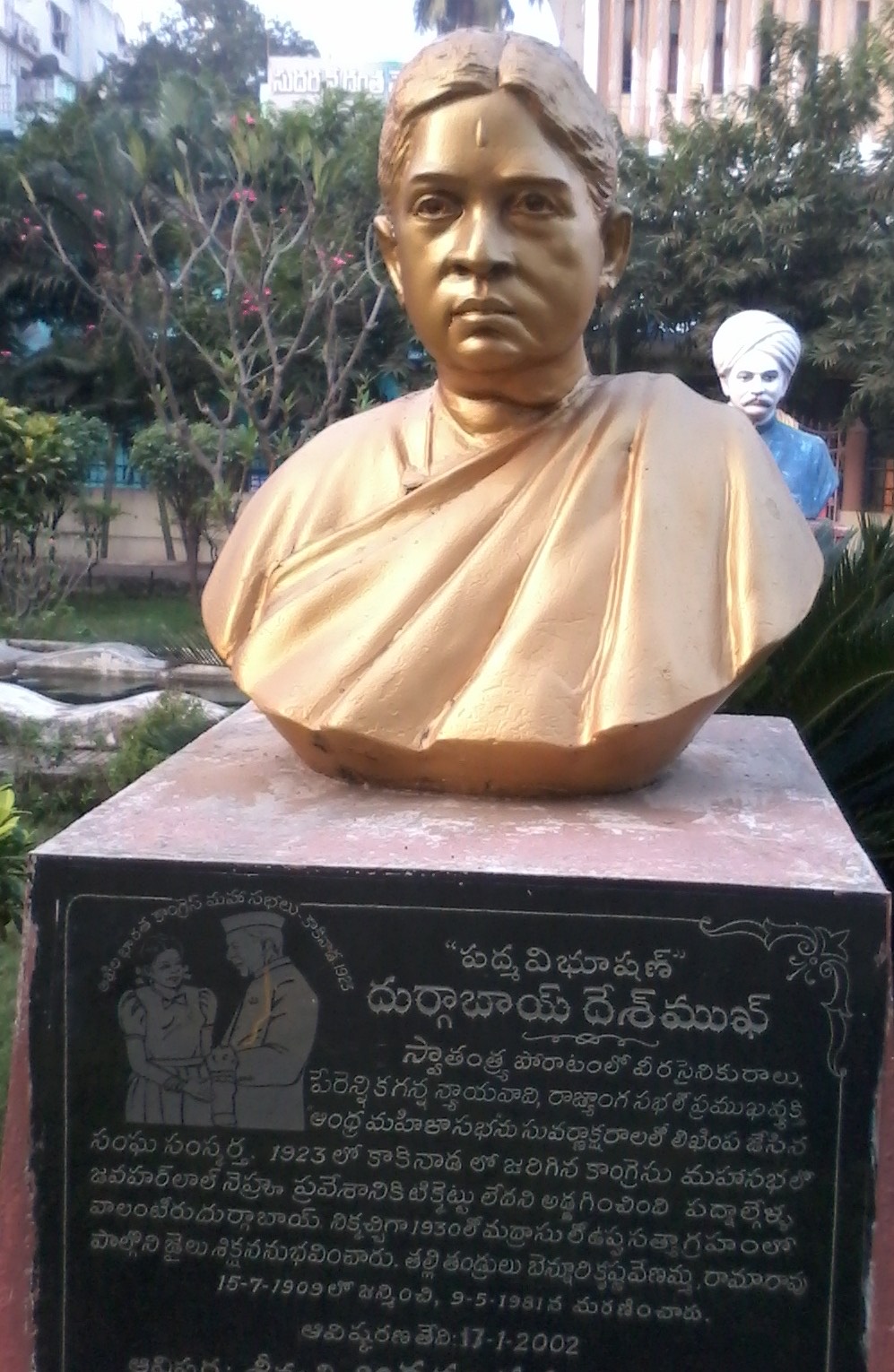
A gilded bronze bust of Durgabai Deshmukh on a stone plinth in a garden, with a Telugu inscription carved into the black plinth below.
MemorialA bust of Durgabai Deshmukh on a public plinth. The Telugu inscription records her as a Padma Vibhushan awardee, a soldier of the freedom struggle, a renowned advocate and a prominent voice in the Constituent Assembly; names her parents as Krishnavenamma and Rama Rao; gives her dates as 15 July 1909 to 9 May 1981; and refers to the 1923 Congress session at Kakinada and to imprisonment during the 1930 salt satyagraha at Madras. It records the unveiling date as 17 January 2002.

The later years

In January 1953 she married Chintaman Dwarakanath Deshmukh, then Finance Minister of India and formerly the first Indian Governor of the Reserve Bank. Jawaharlal Nehru was one of the witnesses. It is from this marriage that the surname by which she is now known comes; the Constituent Assembly knew her as G. Durgabai.

The marriage was also a working partnership. The Council for Social Development, begun in 1962 as a study group at the India International Centre, was led by the two of them together, and when it was registered as a society in 1970 he was its President and she its Executive Chairperson and Honorary Director.

She continued in that work into her seventies. Her account of the Andhra Mahila Sabha was published as The Stone That Speaketh, and her autobiography, Chintaman and I, appeared in 1980, the year before her death.

Recognition

Awards and honours

Listed with the years that reliable sources agree on, and without years where they do not.

  • 1971Nehru Literacy AwardFor her contribution to the promotion of literacy in India.
  • 1975Padma VibhushanIndia's second-highest civilian honour, conferred by the Government of India.
  • Year variesPaul G. Hoffman AwardWidely recorded; the year is given as 1971 in some accounts and 1975 in others, so no year is asserted here.
  • Year not settledUNESCO award for literacy workReported across sources without a consistent year or the exact name of the prize.

Some accounts additionally list a “Jeevan” award and a “Jagadish” award. These appear without institutional detail in the sources consulted, and are noted here rather than presented as established.

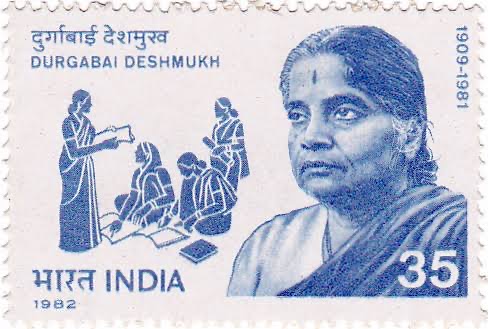
An Indian postage stamp printed in blue, showing Durgabai Deshmukh's portrait at the right and a drawing of a woman teaching seated women and children at the left. It reads Durgabai Deshmukh, 1909 to 1981, India, 1982, 35 paise.
Commemorative stamp, 1982India Post issued a 35 paise stamp in her memory in 1982, the year after her death. It sets her portrait beside an image of adult education — a woman teaching seated women and children — which is how the state chose to summarise her.

How she has been remembered

The stamp is worth dwelling on, because the choice of image is an argument. India Post could have shown a jail, a flag or the Constituent Assembly. It chose a literacy class.

Other memorials follow the same logic. The Central Social Welfare Board instituted an annual award in her name. Andhra University named its women's studies centre after her. The hospital that grew from her fifteen-bed nursing home in Hyderabad carries her name, as do colleges and a locality in the city. The Council for Social Development holds a Durgabai Deshmukh memorial lecture.

Almost every one of these is a working institution rather than a monument. That is an unusually accurate form of remembrance.

Legacy, in four layers

Person, institution, policy, idea

A legacy is rarely one thing. Hers can be read at four depths, and they are not equally well evidenced — the outer layers are the strongest, the inner ones the most interpretive.

Person

The person

A woman who ended her own child marriage, went to prison twice, took her degrees in her twenties, joined the bar at thirty-three and helped write a constitution at thirty-seven. As a demonstration of what was possible, this had a force in her own time that is easy to underestimate now.

Institution

The institutions

The Andhra Mahila Sabha and its schools, colleges and hospital; the Andhra Education Society in Delhi; the Central Social Welfare Board; the Council for Social Development. These still operate, and their continued existence is a fact rather than an interpretation.

Policy

The policy

Social welfare given a permanent place in national planning from 1953; women's education given named administrative owners after 1959; the wording of Article 25(2)(b) of the Constitution. Documented contributions, though never hers alone — policy is always collective.

Idea

The idea

That a right is only as real as the remedy attached to it, and a promise only as real as the institution that carries it. This is the most valuable part of her legacy and the least provable: ideas have many parents, and she would be the last person to claim sole authorship of one.

The unfinished blueprint

A blueprint that has been fully executed stops being interesting. Hers has not been, and the honest way to end this account is with the parts still outstanding — stated as open questions rather than as a programme.

  • Access to education. Enrolment is no longer the binding constraint it was in 1959. Completion, quality and what a certificate is actually worth in the labour market are.
  • Social welfare. Her question — what the state owes directly, and what may be left to voluntary effort — is not settled anywhere in the world, and is argued in India every budget.
  • Women's participation. Fifteen women sat in the Constituent Assembly out of roughly 299. The proportion of women in Indian legislatures has risen since, slowly, and the debate about how to change it is live.
  • Legal literacy. Her 1948 point stands unaltered: a person who does not know a right exists, or cannot afford to assert it, is in the position of a person without the right.
  • Institution building. The organisations she designed have outlived her by more than four decades. Whether the current generation of Indian institutions is being built to last as well is a fair question to ask of them.

These are put as questions on purpose. This site takes no position on contemporary policy, and Durgabai Deshmukh is not available to be recruited to anyone's argument.

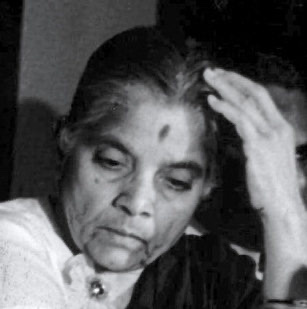
Black and white photograph of Durgabai Deshmukh in later years, her head slightly bowed and one hand raised to her forehead.
PhotographDurgabai Deshmukh in later years. Occasion, place and date unrecorded.

Why she matters to three different histories

To women's history, she is evidence of how a particular generation crossed from the national movement into the machinery of the state, and of how narrow that passage was: fifteen women out of some three hundred members, none of them there by reservation.

To the history of Indian institutions, she is one of the clearest cases of the founding generation's characteristic act — converting the improvised organisations of a movement into permanent public bodies with statutes, budgets and successors.

To the history of social policy, she is the person who kept insisting, from the floor of the Constituent Assembly in 1949 through the Planning Commission and into the Central Social Welfare Board, that a Directive Principle without money and an office behind it remains, in her word, a pious declaration.