1909
Born at Rajahmundry
Why it matteredBorn on 15 July into a Telugu family of the Madras Presidency, she grew up inside the society she would later spend fifty years trying to reorganise.
Sheet 01 Rajahmundry → Kakinada → Madras → Delhi → Hyderabad Drawn from the public record
15 July 1909 — 9 May 1981
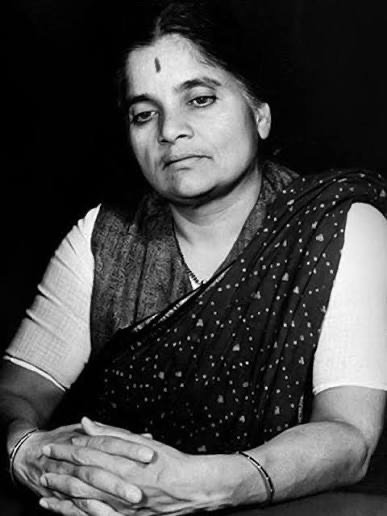
Durgabai Deshmukh · photographic portrait, undated
The question this life answers
Independence was won by a movement. What came after it had to be built — in classrooms, in courtrooms, in committee rooms, and in organisations that could outlive the people who started them.
Durgabai Deshmukh spent the first half of her life helping to end colonial rule and the second half constructing the institutions a free country would need. She went to prison in 1930 for making salt. She took her degrees afterwards, in her twenties, and enrolled as an advocate at the Madras Bar in 1942. She was one of fifteen women in the Constituent Assembly. She then built schools, hospitals, hostels and a national board for social welfare — and argued, in public and in print, that a republic is only as real as the services it can actually deliver.
Her life is usually shortened to a single phrase — freedom fighter. That phrase describes about a decade of it. The rest belongs to a slower and less photogenic kind of work: drafting rules, chairing committees, raising money, finding premises, training staff, and returning year after year to the same unglamorous questions.
This site follows that second half as carefully as the first, and separates what the historical record establishes from what later admirers have added to it.
Diagram 01
One person, drawn out into eight fields of work. Follow any line to read that chapter.
Verified milestones
Nine dated moments, each one a piece of structure rather than a scene. Where a date is disputed in the sources, it is said so.
1909
Why it matteredBorn on 15 July into a Telugu family of the Madras Presidency, she grew up inside the society she would later spend fifty years trying to reorganise.
1922
Why it matteredAt about twelve she gave up English-medium schooling during the Non-Cooperation movement, and began teaching Hindi to girls at Kakinada — the Balika Hindi Pathasala. Her first protest and her first institution were the same act.
1923
Why it matteredAs a teenage volunteer she managed the khadi exhibition at the Congress session. Twenty-six years later she reminded the Constituent Assembly of the hundreds of Kakinada women learning Hindi that year.
1930
Why it matteredShe organised and joined the salt satyagraha in Madras in May 1930 and was imprisoned. Accounts differ on the exact terms; imprisonments in both 1930 and 1932 are well attested.
1937
Why it matteredBegun in Madras from a house in Mylapore, it became her permanent instrument — classes, hostels, training, later colleges and hospitals. Some records date the formal founding to 1936.
1942
Why it matteredShe read law at Madras University and began practice as an advocate. The law gave her the technical vocabulary she would use in the Constituent Assembly four years later.
1946
Why it matteredShe signed the Assembly's register on 9 December 1946 for Madras (General) — one of only fifteen women among some three hundred members, and among the most frequent speakers of them.
1952
Why it matteredDefeated in the first general election, she was appointed to the Planning Commission — its first woman member — and given charge of social services in the plan.
1953
Why it matteredCreated by government resolution to fund and support voluntary welfare organisations, with Durgabai as founder chairperson. It made social welfare a permanent line of national policy.
In closing
By the time she died in May 1981, the things Durgabai Deshmukh had helped start were mostly no longer hers. The Andhra Mahila Sabha had become schools, colleges and a hospital in two cities. The Central Social Welfare Board had become an arm of government. The Council for Social Development, begun as a study circle in 1962, had become a research institution. The report she chaired on women's education in 1958–59 had entered the policy vocabulary of the country.
That is the honest measure of her public service: not a monument, but a set of working arrangements that other people inherited and kept using. It is also the fairest test to apply to her — and the one she applied to the Constitution itself, when she told the Assembly in November 1949 that a seat in Parliament should be “a post of duty and of heavy responsibility” rather than a position of prestige.